Origins of the Human-Nature Separation in Western Thought
In this second article, I explain the inherent limitations of Western ‘epistemology’ (way of knowing the world) in addressing the current ecological crisis. The Western worldview is based on the separation between humans and nature – I argue that a worldview that sees humans and nature as separate entities cannot possibly address the environmental crisis at hand, as it obscures the fact that humans are an integral part of ecosystems and have an active role to play as stewards of the land. The limitations of the Western way of knowing the world justify turning to Indigenous worldviews where human and non-humans are understood as kin in a shared world.
In many Indigenous languages, there is no word for ‘nature’. Dr Hinemoa Elder, in her book Aroha, writes that ‘We Māori believe that we are intimately bound to our land. Our word for placenta is the same as our word for land, whenua. This dual use signals our profound connection with both types of whenua […] We identify ourselves by the history of our lands, oceans, rivers and lakes. Without our lands, we do not exist - in our worldview, we are the land, and the land is us’ (2020, p.5). Such an understanding of humans’ place in the world could not be further removed from the Western separatist view of humans and nature. The Western worldview is largely structured by binary oppositions: good-evil, reason-emotion, human-nature, male-female, black-white, etc. In their book A History of the World in Seven Cheap Things: A Guide to Capitalism, Nature, and the Future of the Planet, Raj Patel and Jason W. Moore (2017) argue that the human–nature binary underlies and sustains all other dualistic opposition in the Western worldview. So, how did the West come to understand itself as separated from nature?
I spent the first year of my PhD conducting an extensive literature review trying to answer this question. By reading countless articles and books, I found that the origins of the great sense of alienation and estrangement from the natural world in the West can be traced back to the ideas of Greek philosophers. Plato, an emblematic figure of Greek philosophy, is famous for introducing the concept of the separation of the mind and the body. In Plato’s work, The Republic, and more specifically in his ‘Theory of Forms’, he argues that the world is divided between the world of Forms – the ideal, eternal and unchanging world – and the physical world – the changing, imperfect and perceived through senses world. For Plato, the human capacity for reasoning, in other words, the mind, becomes the tool to access the realm of Forms, set apart from the physical, material world. Therefore, while the mind is associated with reason and intellect, the body is related to the physical, so the non-rational, the disorderly, and the unknowable, which is to be set aside in the cultivation of knowledge (Lloyd, 1984). Therefore, for Plato, it is through the mind, disconnected from the material world, that we shall gain knowledge. In such a view, knowledge becomes attainable from one’s own rational abilities, by going inwards into the mind, in total disconnection from one's surroundings. With this theory, Plato elevates the human intellectual and rational capabilities above the material and natural world.
It is the human capacity for reasoning that Plato used to justify placing humans above all other life forms in the social hierarchy of life, with anthropocentric consequences to this day (Cronon, 1996; Escobar, 1999; Moore, 2015; Patel & Moore, 2017).The term ‘anthropocentrism’ derives from the Greek ánthropos for ‘human’ and kéntron for ‘centre’, reflecting the idea that humankind is the central or the most important element of existence, due to its capacity for reasoning (Tamale, 2020). Anthropocentric ideas have persisted over time, notably during the Enlightenment, with thinkers such as René Descartes who reinforced a binary (or ‘Cartesian’) worldview in which humans are separated from the rest of the world by their capacity for reasoning. Francis Bacon introduced a hierarchical dimension by asserting that nature exists solely to serve human needs. Thus, Bacon builds on Plato’s ideas about the separation of the mind and the body but takes them a step further by arguing that the mind is a tool for mastering the physical world (Lloyd, 1993). The human capacity for reasoning, therefore, becomes the justification for the separation of humans and nature and the dominance over the latter.
Ultimately, the introduction of capitalism institutionalised the human-nature divide on a global scale. Capitalism’s innovation was to turn the human-nature distinction into a ‘hard-and-fast separation—and into an organising principle’ (Patel & Moore, 2017, p. 51). It is the process of enclosing nature to introduce the concept of private property, fundamental to increasing productivity and kick-starting capitalism, which reduces ‘nature’ to ‘land’ to serve human interests. In The Great Transformation, Karl Polanyi argues that ‘what we call land is an element of nature inextricably interwoven with man’s institutions. To isolate it and form a market for it was perhaps the weirdest of all the undertakings of our ancestors’ (Polanyi, 1944, p. 187). The introduction of capitalism cemented the move away from a communal, reciprocal relationship with nature, grounded in shared use and collective stewardship, toward ownership of the natural world for human use.
In that sense, capitalism is more than just an economic system; rather, it is an organising principle that organises human relationships with nature so that the latter serve human needs (Moore, 2015). Such an understanding of nature as a property, existing for value extraction directed towards human ends, regardless of natural cycles, and oriented towards maximising profit, has been exported as the main economic model through processes of colonialisation. Expanding capitalism on a global scale engendered colossal violence, inequality, and oppression. Imposing an understanding of nature as external and existing solely for humans’ ends came with the attempt to erase the diversity of Indigenous ways of knowing and being.
It is worth questioning, though, who is the ’human’ that is referred to when writing that nature only exists to serve ‘human needs’ in the Western worldview? Engaging with the work of the Black feminist author Sylvia Wynter reveals that not only is the Western worldview based on opposing human and nature to serve the needs of the former, but that the White, bourgeois man is the accepted norm of humanity itself, excluding many human experiences from its model. In Sylvia Wynter: On Being Human as Praxis, Katherine McKittrick argues that ‘we have come to and produced our contemporary conditions of being human – wherein ‘Man’ is the measuring stick of normalcy, and Man’s human Others are excluded from the category of being’ (2015:190). In their article about Wynter’s work, Jennifer D. Adams and Matthew Weinstein further this idea: ‘Our thinking of humanity is therefore grounded in colonial logics that erased the humanity of Black and Native peoples and continues to work in the service of White patriarchy, against immigrants, non-gender binary, differently abled, and so on’ (2020:238). Therefore, the separation of humans from nature does not serve all humans’ needs but rather those of a small elite while working to erase the worldview of many peoples around the world. Not only nature, such as forests, oceans and animals, is being ‘put to work’ to serve human needs, but the lives of many human beings, especially women, Black and native peoples’ lives and labour are being exploited. Patel and Moore write that ‘the realm of Nature included virtually all peoples of color, most women, and most people with white skin living in semicolonial regions (e.g., Ireland, Poland)’ (2017, p.51).
Overall, in this short essay, I aimed to share an overview of my findings from the first year of my PhD, spent conducting a literature review on how the West came to understand itself as separated from nature. Understanding how deep the separation between human and nature lies in the Western worldview – and how far it goes back to (Greek philosophers in the fourth century BCE!) made me realise how our language (here English), ways of understanding ourselves and the world is structured around a denial of nature’s agency, negating her voice, and making her work to meet anthropocentric needs. Engaging with Sylvia Wynter’s work on who is considered ‘human’ is essential to grasping that the separation between human and nature is much more intricate than separating human beings from non-human beings, and rather stresses that many humans’ lives, notably those of women, people of colour, Indigenous and Black peoples, are and continue to be exploited to serve the needs of the White, bourgeois man accepted norm of humanity itself. It therefore becomes necessary to move away from a system of thought that makes a strict separation between humans and nature, including many human beings in the latter category, to mobilise, engage with, and get inspiration from Indigenous worldviews, which are grounded in an understanding of the interconnectedness of all living beings.
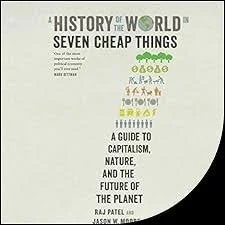
Note: I am aware this is quite a theory-heavy piece. I’ve tried my best to condense it into a digestible format, but if you want to engage with this a bit more, I strongly recommend Raj Patel and Jason W. Moore’s book A History of the World in Seven Cheap Things: A Guide to Capitalism, Nature, and the Future of the Planet (2017). The language is accessible, and in seven chapters, the book walks you through how capitalism, as an organising life principle, rendered nature, work, care, and many other things ‘cheap’ in order to exploit these resources. One of my favourite chapters is “Cheap Nature,” available online here:
I believe the whole book is also available as a free PDF online.
Sources
Adams, J.D and Weinstein, M. (2019) ‘Sylvia Wynter: Science Studies and Posthumanism as Praxes of Being Human’, Cultural Studies, 20(3):235-250.
Cronon, W. (1996). The Trouble with Wilderness; Or, Getting Back to the Wrong Nature. Environmental history, 1(1), 7-28.
Elder, H. (2020). Aroha: Maori wisdom for a contented life lived in harmony with our planet. Random House.
Escobar, A. (1999). After Nature: Steps to an Antiessentialist Political Ecology. Current anthropology, 40(1), 1-30.
Lloyd, G. (1993). The man of reason : "male" and "female" in Western philosophy (Second edition. ed.). Routledge.
McKittrick, K. (2015). Sylvia Wynter : on being human as praxis. Duke University Press.
Moore, J. W. (2015). Capitalism in the web of life : ecology and the accumulation of capital. Verso.
Polanyi, K. (2002). The great transformation. Readings in economic sociology, 38-62.
Tamale, S. (2020). Decolonization and Afro-feminism. Journal of Contemporary African Studies.