Fieldnotes in Aotearoa New Zealand: acknowledging our relationship with the Earth
In this third article, I share some thoughts, interview excerpts, and fieldnotes from my diary to reflect on my experience as an academic who grew up in a Western worldview and is researching Indigenous modes of relationality with the more-than-human. I ask more questions than I answer, and hope to create an ongoing dialogue on whether and how Westerners/non-Indigenous peoples can engage with Indigenous peoples' ways of living with nature while resisting appropriating a culture that is not theirs.
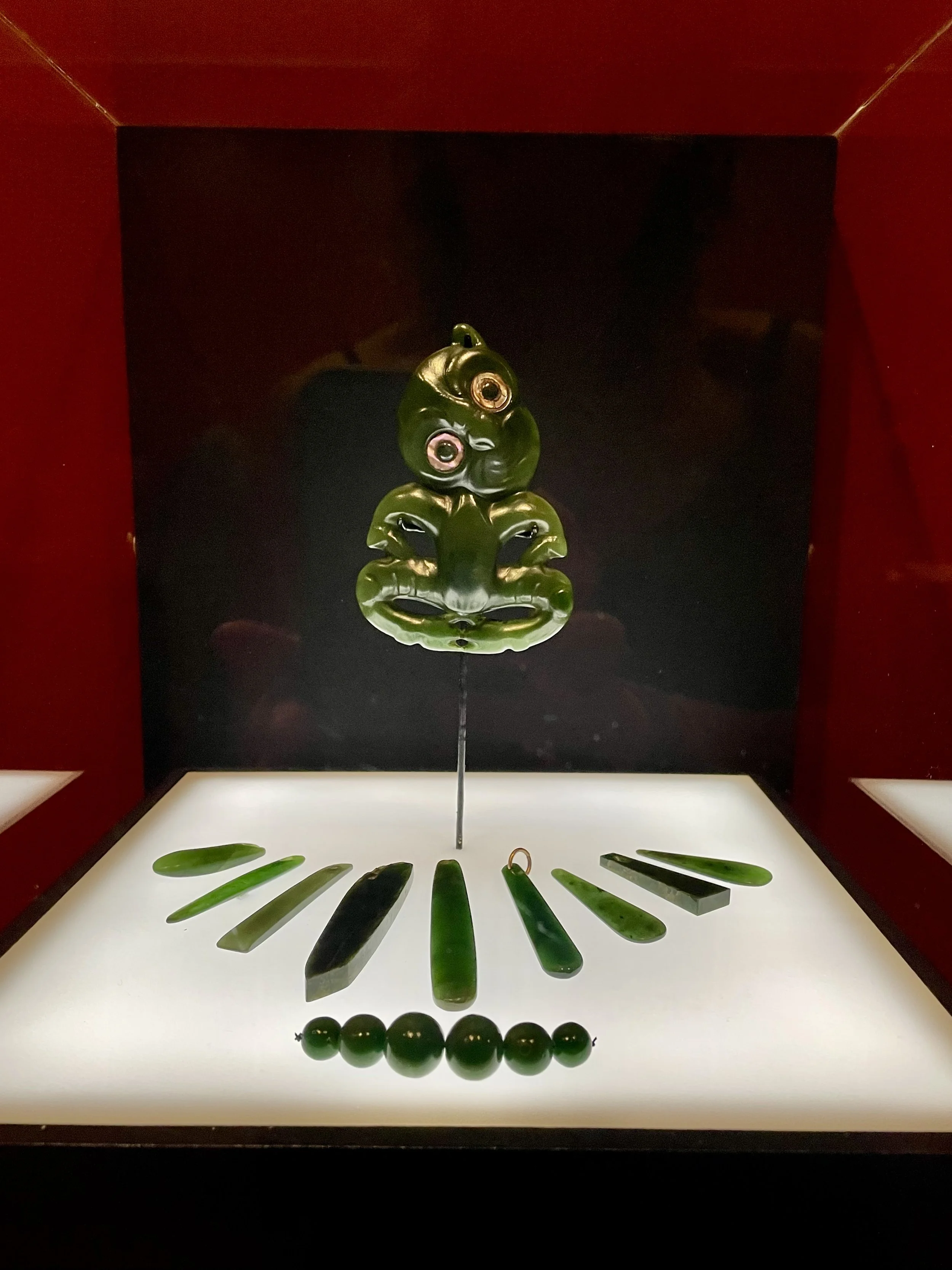
About a month ago, I arrived in Aotearoa and started unpacking some preconceived assumptions, which led me to challenge my own worldview. More commonly known by its colonial name, New Zealand, which comes from the Latin Nova Zeelandia or Nieuw Zeeland in Dutch, was first given by Dutch cartographers following Abel Tasman’s voyage in 1642 and later popularised in English by James Cook after his arrival in 1769. However, contrary to what I initially thought when arriving in the country, I learnt that Aotearoa’ is not merely the Māori name for New Zealand. Aotearoa, which translates to ‘land of the long white cloud’, ' long white cloud’ or ‘long bright land’, is certainly what New Zealand is now called by most Māori of the modern era (King, 2003, p. 30), yet in pre-European times, Māori had no name for the country as a whole. Not naming to the country as a whole can largely be explained by the fact that Māori identify with separate iwi (tribes) and hapū (sub-tribes) and, before European contact, did not think of New Zealand as a single nation-state. In an interview I recently had, I was told that ‘the iwi would be like the country, and then the hapū would be like the states in a federal system’. The North Island was known principally as Te Ika-a-Māui, meaning ‘the fish of Māui’, in recognition of the widely accepted belief that the land had been fished from the depths of the ocean by the demi-god Māui. The name ‘Aotearoa’ was also sometimes used to refer to the North Island. The South Island was known, among other things, as Te Waka-a-Māui, referring to the canoe Māui stood on while fishing the North Island and as Te Wāhi Pounamu or Te Waipounamu, referring to pounamu, the precious greenstone found in the South Island of Aotearoa New Zealand (see picture).
I believe addressing this common confusion opens a fascinating window into a Māori worldview, notably in relation to identity. Stories of creation are useful entry points into the general worldview of a particular tradition (Haberman, 2020); therefore, it is relevant to present a brief narration of the Māori creation story. Note that there are multiple versions of this story. I am merely transcribing what I have read online here. The Māori creation story begins with Te Kore (nothingness) until Ranginui (Sky Father) and Papatūānuku (Earth Mother) emerge. Initially, earth and sky are joined together, and their children are born between them. Longing for light and space, the children debated what to do until Tāne (God of the Forests) decided to lie on his back with his legs facing up to separate his parents. His father rose above, and his mother was pushed downwards. Tāne then clothed his mother in trees and plants and clothed his father in the sweat of his brows to become the stars that adorn the sky. Ranganui was grieving his love for Papatūānuku. ‘Kei te heke ngā roimata o Ranginui’ (The tears of Ranginui are falling) is said when it is raining, as these are Ranginui’s tears about their separation. Following their separation, Te Ao Mārama (the World of Light) was formed, bringing into being the natural world: the mountains, rivers, forests, and all living creatures within it. From this story, it becomes evident that in a traditional Māori worldview, every living being, human and non-human have shared origins, implying that all are connected into a single-family tree through whakapapa (genealogical links).
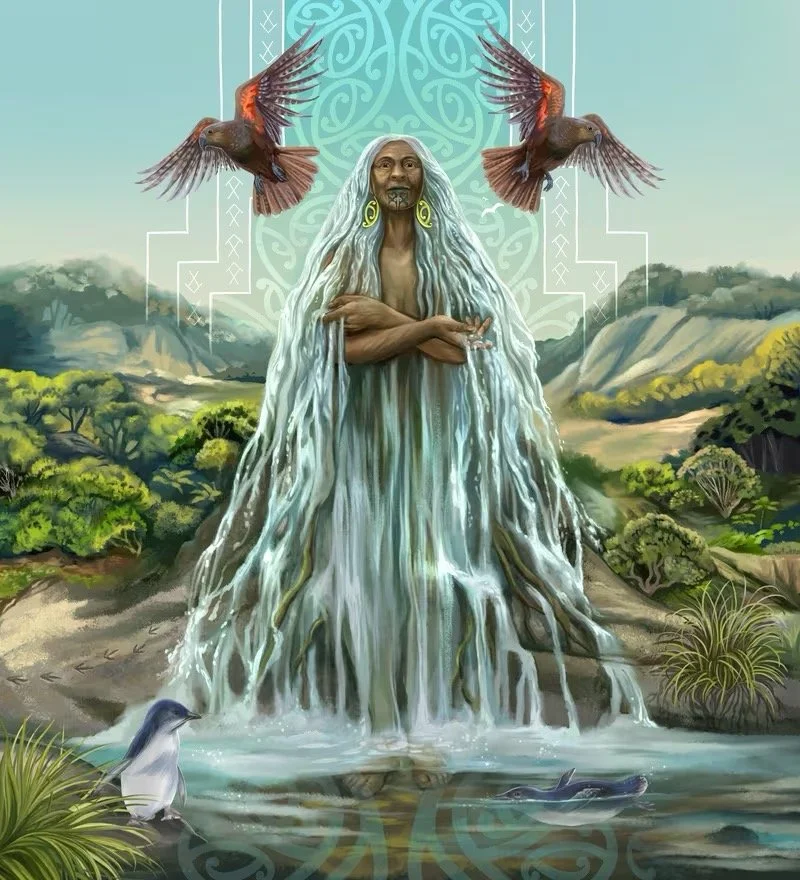
Accounts of creation are not just ‘stories’ but performative enactments of how a worldview comes into being. Ontological frameworks are enacted through (creation) stories, practices, and nonverbal actions. For example, it is common practice for Māori to introduce themselves through pepeha, a traditional way of introducing oneself by sharing connections to the mountain, the river, the tribal ancestor, the tribe, the family, and, lastly, one’s name (Tuhiwai Smith, 2019, p. 126). Through such practice, it is evident that Māori’s understanding of identity is not individual but collective and grounded in place, with humans and non-humans as kin. Māori are rooted in a reality that emphasises the inherent connectivity through genealogical links between humans and the more-than-human (Yates, 2021). During an interview at the ecosanctuary of Zealandia in Wellington, when discussing a beautiful artwork hanging on the wall (see picture), Terese captured this connection:
“The concept is about explaining that Māori see natural assets as family members. So, it’s a way to convey that in that picture. And so that’s quite powerful because when I’m meeting here with officials, I get them to look at the image and say, from our perspective, when you pour that pollution, you’re drowning her in pollution, you’re pissing on her, that sewage is going on her, and that can silence a room and that can shift perceptions and connect people to how another people see the stream. It’s not just a stream. It is a person. It is an energy represented as a family member. So that stream… me and my cousins view her as a female entity.”
From a theoretical point of view, I understand what Terese is telling me. I have written my last article on the separation between human and nature in the Western worldview, see here, demonstrating how deep that separation between human and nature lies, and how far it goes back to and how capitalism institutionalised that divide on a global scale. From doing the research to write this previous article, I know that Indigenous worldviews offer an alternative to this binary mode of thinking and emphasise the interconnectedness of all living beings. Yet, here I am, confronted with my own internal bias from the Western worldview in which I grew up, (see the article about positionality). I respect my informant's perspective, but I struggle to fully grasp it or understand it deeply. It does not fully resonate with me. I hear it, and I think ‘this is their way of thinking, not mine’. I accept that as my own limitations, attempting to understand Māori values using my Western framing of life is only going to further reveal its inadequacy, as ‘it is not possible to capture the entirely different philosophical underpinnings of Māori knowledge and ideas’ with Western concepts and words (Brannelly et al., 2013, p. 411). I highly doubt anyone can ever fully transcend the worldview in which they were born, especially not me, within only five months I have here in Aotearoa New Zealand. Yet, I am really motivated by attempting to challenge my Western framing of human-nature relations.
I believe this is the start of a commitment to think profoundly about whether and how Westerners/non-Indigenous peoples can engage with Indigenous peoples' ways of living with nature while resisting appropriating a culture that is not theirs. I believe there are important ethical questions here that I am still grappling with, but if I decide to write about this while still thinking through it, it’s not only because writing is a form of deep thinking, but also because I recognise that I might never reach an ‘answer’ to these questions. Instead, I try to open up a dialogue. In my attempt to start seeing and thinking differently about the natural world around me, I turn to ‘slow academia’. In their book, The Slow Professor, Berg and Seeber write that ‘we do need time to think. We do need time to digest. We do need time to misunderstand each other, especially when fostering lost dialogue’ (Berg & Seeber, 2025, p. 17). Instead of claiming to have the answer to the difficult questions I ask, I accept that I'm in a messy process of trying to make sense of it, by getting lost in thoughts, reading, researching, connecting with people whose insights inform my thinking, etc. Further, Berg and Seeber suggest that to ‘think critically and creatively, or even just to be able to think straight, we need, as Ylijoki and Mäntylä point out, ‘timeless time’.’ Timeless time is referred to as ‘periods of escape from time [which] are actually essential to deep thought, creativity, and problem solving’ (idem). Further, they suggest that ‘timeless time fosters creativity, original thinking, and joy’ (Berg & Seeber, 2025, p. 18). Extreme workloads, time pressures, and unrealistic expectations of productivity make it virtually impossible for individuals to experience timelessness (idem). The authors then go on to make a list of recommendations for protecting ‘a time and a place for timeless time, and to remind ourselves continually that this is not self-indulgent but rather crucial to intellectual work’ (idem). While I was reading this, I was on a three-week field trip. That week, I had no interviews, and the focus was on slowly crossing the South Island from West to East to be in Christchurch the following week for meetings. I had loads of time on my hands, so I let myself embrace timeless time during a two-day hike and overnight camping trip.
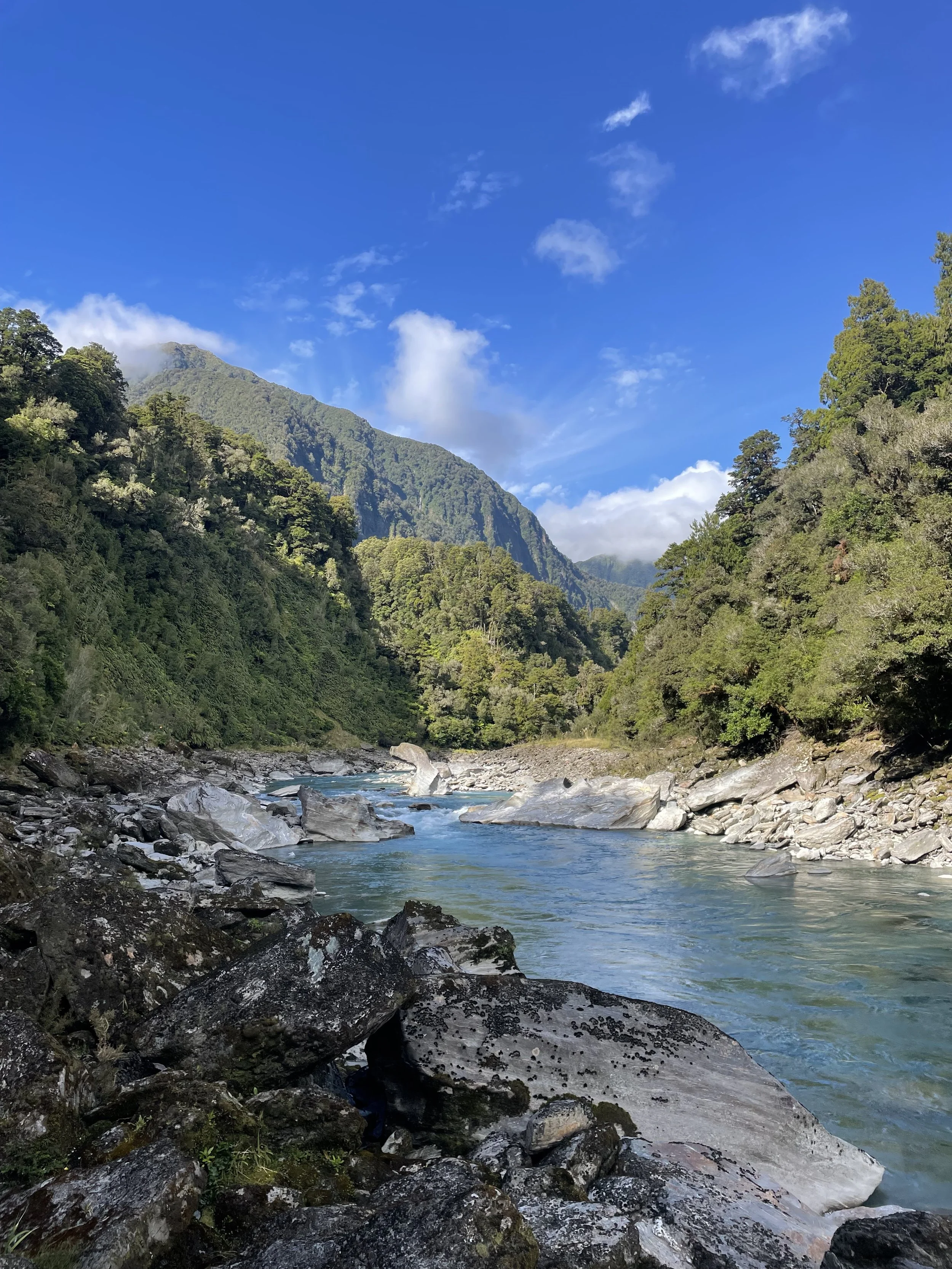
After a day of walking, my partner, Jordan, and I set camp for a night on the shore of the Coupland River on the West coast of the South Island. Without any signal, work pressures, expectations of productivity, or any other humans around, my mind wandered. I had the time, without the usual overwhelming amount of distractions of my day-to-day life, to start thinking about what it meant to me when Terese told me the Te Kaiwharawhara River is her female relative. In my diary, I journalled, ‘I look differently at rivers now. I try not to just see a body of water but wonder how I can look at her differently. Is she a relative? A friend? Who is she? What’s her name? I try to listen to her… is it even a ‘her’?’. From trying to personify her, the same way it has been done in the picture, I start realising her sacredness, and interestingly, my reaction to that is starting to feel really bad for taking her resources. In my diary, I write: ‘We needed water to prepare food, but when walking to the river to get some water, I started questioning my sense of entitlement to just go up to her and take away her resources…. I start feeling shame and guilt for everything I do, from picking up flowers to make a decorative bouquet to collecting wood for making a campfire. In my mind, I can only make sense of doing such a thing if I can give back to her’. In that extract, I guess ‘her’ refers not only to the river but also to Mother Earth. I start wondering about how to have a reciprocal relationship with nature. How can I give back to thank her for everything she gives me?
After spending a couple of uncomfortable hours picking up pieces of wood to make a fire to put back in place later, because I suddenly realise that I have never asked permission or thanked the Earth for utilising her resources for my own ends, I bring my worries up to Jordan. He asks me a simple question that completely shatters my understanding of it all. He asks me why I feel bad about taking water from the river or wood from the forest when ‘out in nature’ and not when I open the tap at home or go to the supermarket? What difference does it make? He tells me to look around us. I see the river, the mountains covered in rainforest, the trees, and the rocks: ‘this is all there is,’ he says. And I realise. I realise that the water that flows from my tap at home comes from the river I see in front of me at this very instant. I realise that I am in a constant relationship with nature even when I don’t think of it. I realise that every day, to live, I need the Earth’s gifts: the water to drink, the plants and animals to eat, the trees and oceans to give me the air to breathe, etc. The discomfort and shame I experienced earlier probably comes from me beginning to question my entitlement to take nature’s gifts without properly acknowledging them. I start to feel deeply grateful and thankful for the gifts the Earth provides every day, enabling us to live.
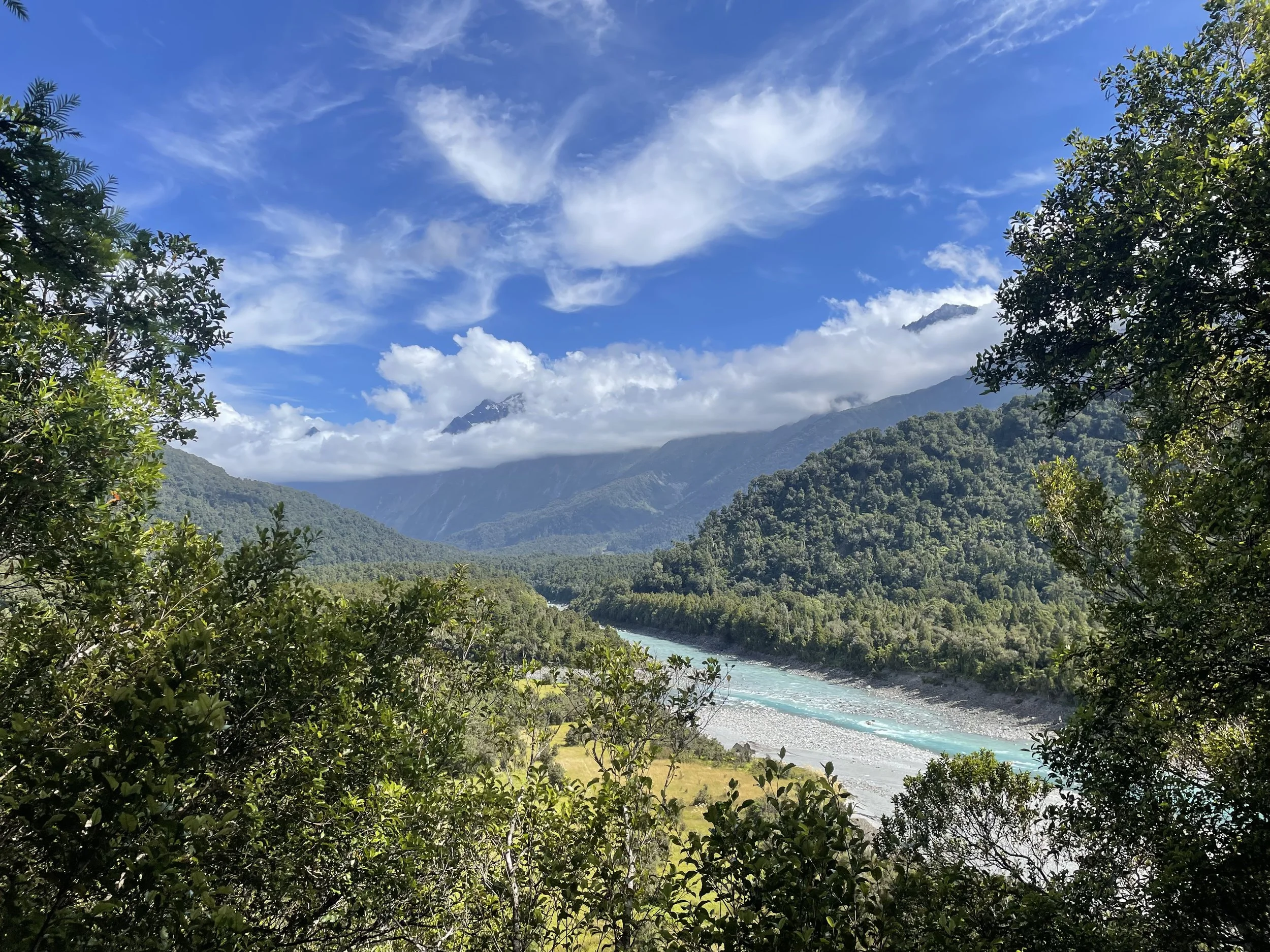
Picture taken by the author of the Coupland River.
A popular Māori story that was shared with me captures the idea of fostering an appropriate engagement with the environment and questioning the Western sense of entitlement to ‘natural resources’. The story starts with a father who one day went into the forest to cut down a tree to build a strong canoe. After cutting it down and removing the limbs, the man returned home to finish the work the next day. The tree was home to many insects and birds, and its destruction angered the forest spirits. So, birds and insects came and sang together to repair the tree down to the very last cut. The next day, when the man returned and was looking for the tree, it was nowhere to be found. As he looked up, he saw a tall and mighty tree. He asked the bugs and birds why they had stopped his work, and they replied, ‘Who gave you the authority to cut our forest god to the ground? You do not have the right!’. He did not perform the sacred chants; he did not seek permission from the forest's inhabitants. The man apologised for his thoughtless act, and the spirits decided to forgive him and grant him permission to the tree. This story is about recognising that trees are not ours, that the food we eat is not ours until we ask for it, until we get it in the appropriate way. It is about acknowledging the relationship we have with the Earth for our survival and respecting the need to hold off taking resources when we do not have permission, i.e., when a certain species or plant needs to recover following a natural disaster.
I started my journey here by questioning colonial place names, and learnt that the story is more complex, as Māori did not refer to New Zealand as the two landmasses that make up the country, because their societal organisation differs from the Western model of the nation-state. Digging into the Māori understanding of identity being tied – not to how Westerners understand themselves as members of a country – but rather grounded in local place, with humans and non-humans as kin. A whole other worldview and way of being in the world opened up. This article is about me trying to deeply feel the research rather than merely documenting the worldview I am researching. What does it mean for me? How does it impact me as a Western/non-Indigenous person? And I wonder: what experiences can lead other non-Indigenous people to reconnect with the environment? What is needed for Westerners to see beyond the culturally constructed and capitalist-orchestrated human-nature divide?
Note:
To read more in-depth about the Māori story of the father cutting down the tree in the forest, you can read it here.
And I strongly recommend watching this short YouTube video about the Māori creation story made in sand, it is so beautiful.
Sources
Berg, M., & Seeber, B. K. (2025). The slow professor: Challenging the culture of speed in the academy. University of Toronto Press.
Brannelly, T., Boulton, A., & te Hiini, A. (2013). A relationship between the ethics of care and Māori worldview—the place of relationality and care in Maori mental health service provision. Ethics and Social Welfare,7(4), 410-422.
Haberman, D. L. (2020). 8. Affectual Insight: Love as a Way of Being and Knowing. Living Earth Community: Multiple Ways of Being and Knowing, 78.
King, M. (2003). The penguin history of New Zealand. Penguin Random House New Zealand Limited.
Tuhiwai Smith, L. (2019). Decolonizing research: Indigenous storywork as methodology. Bloomsbury Publishing.
Yates, A. M. (2021). Transforming geographies: Performing Indigenous‐Māori ontologies and ethics of more‐than‐human care in an era of ecological emergency. New Zealand Geographer, 77(2), 101-113.