On Doing Research: Fieldnotes in Aotearoa (3)
Author’s note: The ideas and analyses presented here are original work. Readers are welcome to discuss and appropriately cite these ideas, but any use, reproduction, or derivative work should acknowledge the original source in accordance with academic standards and applicable copyright law.
In this article, I want to make space for the difficulty and uneasiness encountered in forming meaningful relationships with participants during fieldwork. I attribute this to the ongoing colonial legacies of ‘doing research’. I then explore my encounter with Mina and her family, which left me wondering how we can foster meaningful relationships with participants while conducting fieldwork.
I came back from Aotearoa New Zealand about two and a half months ago. Returning to the United Kingdom has been much more difficult than expected. While I was very excited to get back to a routine and see friends and family, the busyness of life in the imperial core has triggered my nervous system, which, after many months of floating with the waves of the Pacific Ocean, seemed to have finally quietened down. It feels like an almost impossible task to foster calm and ‘timeless time’ (Berg & Seeber, 2025, p. 18), the gateway into the physical and spiritual space needed to appreciate our interconnectedness with the Earth (see Fieldnotes in Aotearoa 1). I am back in the UK, and my heart aches for the ‘bush’, referred to as Aotearoa’s jungle, with its seemingly never-ending living layers of trees, ferns, shrubs, and vines. I find solace in the last standing trees of the UK’s depleted forests, and I yet yearn to hear the voices of my friends, the pīwakawaka, the kererū and the tuī.
I have always cherished feeling nostalgic. It brings me back to the past and seems to hover a shiny gloss over all the difficulties and hard times experienced, leaving only the tender memories. Yet, it would be an inaccurate depiction of my time in Aotearoa if I only narrated about my beautiful interactions with the more-than-human world. Given the nature of my research, I predominantly relied on human informants. I conducted about 50 interviews during the 10 months away from home in the Highlands of Scotland and Aotearoa New Zealand. While it has been an incredibly rewarding and life-transforming experience, conducting fieldwork has also brought challenges and difficulties that I want to give space to, challenging nostalgia’s warm tint on my memories.

While conducting ‘fieldwork’ can easily be romanticised as travelling to far-away countries for many months in a row, engaging with people and communities distant from one’s own culture, and fostering long-lasting memories, it is inseparable from its origins in the broader European colonial project. Fieldwork originated with ‘single men travellers and explorers going on “expeditions” … [these] expeditions were meant to “civilise” locals and explorers would “speak for them” when reporting findings back in Europe’ (Caretta & Jokinen, 2017, p. 275; Katz, 1994; Sharp & Dowler, 2011; Tuhiwai Smith, 2019). Therefore, fieldwork, which became a rite of passage in social science disciplines from the second half of the nineteenth century and remains so to this day, is in its very essence designed to be exploitative and appropriative (Boer Cueva et al., 2024, p. 3). Due to its ongoing neocolonial legacies, academia is met by a growing resistance to engaging in fieldwork and ‘has paralysed some scholars into avoiding fieldwork’ (Sultana, 2007, p. 375). Yet, acknowledging one’s positionality in the research process should not mean abandoning fieldwork; rather, ‘it should strengthen our commitment to conducting good research by building relations of mutual respect and recognition’ (Peake & Trotz, 1999, p. 37).
It is precisely the commitment to conduct ‘good’ research which has led me to experience a sense of failure (Rose, 1997). I set out on fieldwork with the best of intentions: to challenge the way research is done, and to be an approachable, kind researcher, unlike the male explorers of the nineteenth century. I would not only ‘extract’ data from informants but foster meaningful relationships with participants. I am afraid of having failed (Haverkamp, 2021). Not unlike many others, my fieldwork experience starts with a lot of cold emailing and unanswered phone calls, in the hope of reaching someone generous enough to take the time to support my research. When I finally get through, and the date and time of the meeting have been set, and the participant information sheet and the consent form signed, I only have a couple of hours maximum to build a meaningful relationship that exceeds treating interlocutors as ‘mere mines of information to be exploited by the researcher’ (England, 1994, p. 82). During the interview, the opportunity to foster such relationships withers as I pull a notebook from my backpack, with a list of questions prepared in advance, and place the audio recorder on the table. Conscious of the need to keep the interview to a maximum of two hours, as stated on the consent form, I have little time left to develop the relationship further once I have asked all my questions. Instead, I thank the informant. We shake hands. I am grateful to have collected more data for my research, yet I am unsure whether I have done ‘good’ research.
While it may well be my own approach to fieldwork that has led me to experience a sense of failure, I cannot help but wonder whether I am merely confronting the very nature of doing research in a neocolonial academic setting. I am aware of the plethora of literature on decolonial research methods. This includes, for example, Participatory Action Research (PAR), which requires deep partnership and a commitment to benefits for the researched community. I wonder whether my lack of engagement with these methods, mostly due to a lack of time for adequate training, is something to blame on me as an individual or on the system in which I operate? What if the ‘lack of time for adequate training’ is a structural condition of operating within the legacies of a colonial extractive system of gathering knowledge? What if ‘no method is inherently decolonial [instead] its decoloniality depends entirely on the power structures it is embedded in’? (Camfield, 2025, p. 427). Therefore, ‘what does it mean to be a decolonial researcher working within the same institution that legitimised this theft of knowledge? (Tynan, 2024, pp. 143-144). While I might not have an answer to this question, I have had encounters in the field that not only brought me immense joy but might also constitute an alternative way of doing research. One that slows down the research and creates opportunities to develop relationships. To this effect, I want to share my raw fieldnotes of a spring weekend spent in Tinopai, Aotearoa, April 2025:
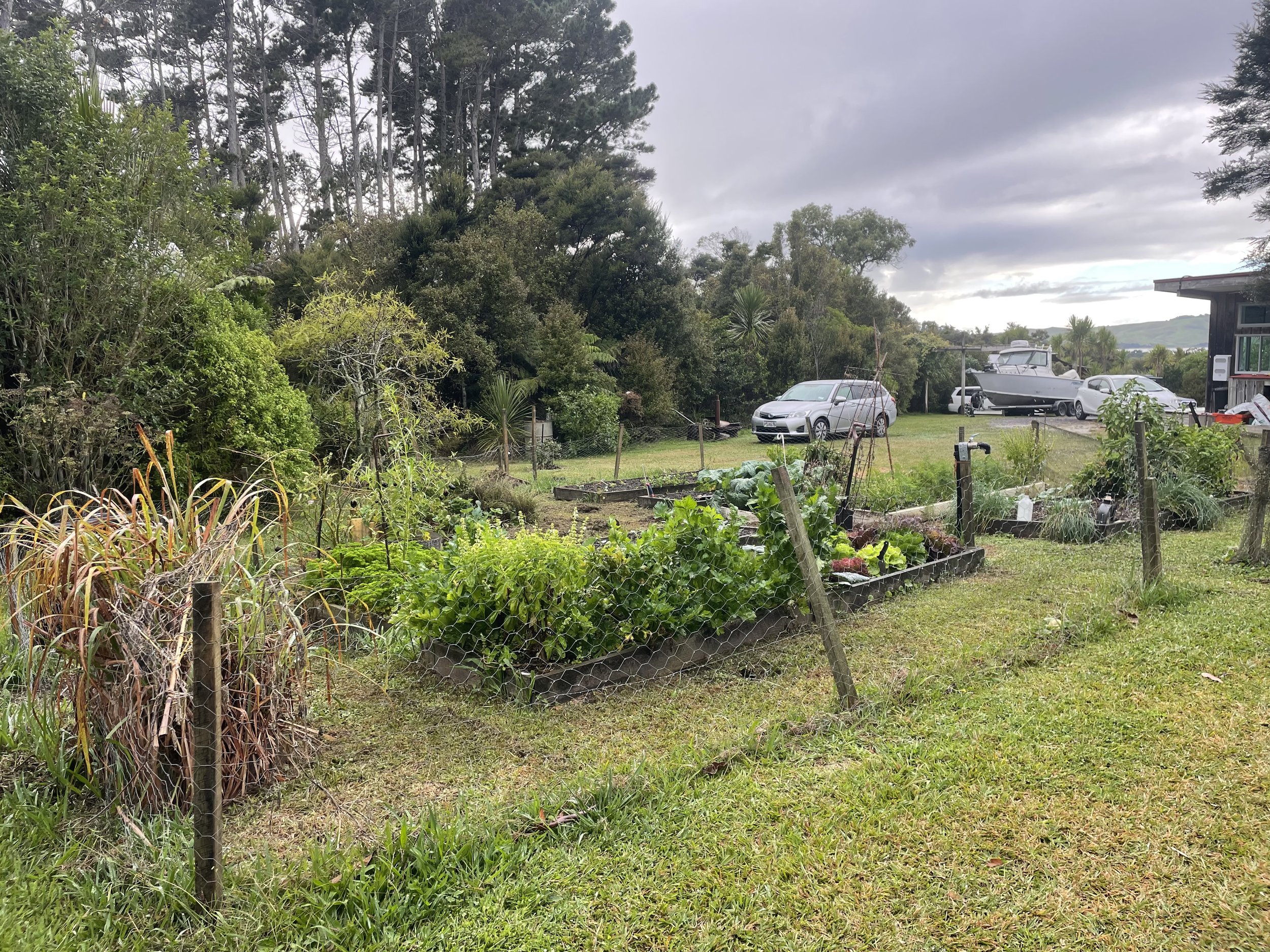
‘I want to write some thoughts down while they’re still fresh. I interviewed Mina on Wednesday this week. Instead of meeting in a café, where I usually meet with people for interviews, she suggested meeting at the local school. There, Mina, in her role as kaitiaki (environmental and spiritual guardian), facilitated a monthly outing of a small group of children involved in monitoring the water quality of their community. After sending off the kids to collect water samples and learn about the health of the local streams, Mina and I went to her house to conduct the interview. She preferred not to be audio recorded, so I scribbled notes as fast as I could in my notebook to capture all the valuable information she shared. After an hour of conversation, the kettle Mina had placed on the log burner sizzled away, announcing teatime and prompting the end of the interview. She offered me some homemade chocolate cake, which I had more than one slice of with the warm herbal tea. We spent another half hour together, in her living room, getting to know each other beyond the confines of my interview questions. It didn’t feel rushed. We were both present in this moment. She invited me to come back the next weekend for a hāngī (a traditional Māori method of cooking food in an underground pit using heated stones and steam) on the school grounds. So, I came back a few days later.

On Friday, my partner and I drove up from Auckland straight to Tinopai marae (Māori meeting place). Mina’s nephew welcomed us onto the site with a short karakia (prayer, blessing). In the wharekai (marae’s kitchen), we joined a group of over 30 people busy preparing the food packages which would go in the underground oven. A whiteboard listed the tasks that needed doing. We joined in, peeled potatoes, chopped red onions, and made baskets with banana and cabbage leaves to hold the food packages. In under 3 hours, with a large team of volunteers and an efficient packing technique that consisted of dragging the pre-cut foil sheets onto a large working surface akin to an assembly line where each person had the responsibility of adding one ingredient onto the foil: pork, chicken, stuffing, potatoes, pumpkin, cabbage and salt. Together, we prepared over 300 food packages, placed them in baskets, and took them to the hāngī pit.
After the hard work, made easy by the large number of people ready to help, we went back to Mina’s house and had a cup of tea while flicking through her wedding photo album. We started to feel part of the family. After that, more of Mina’s nephews and their friends arrived to spend the Easter week up in Tinopai with their family. None of them questioned our presence in their family home. It was as if we belonged there, almost as if we were also cousins who hadn’t seen each other in a while. Shortly after they arrived, we went to the hāngī pit, where we helped dig the hole. I must admit I didn't contribute much to the digging, which seemed to be primarily a men’s job. Instead, I sat with the women and elders, playing with the overly friendly kids who ran around and jumped in and out of the hāngī pit.
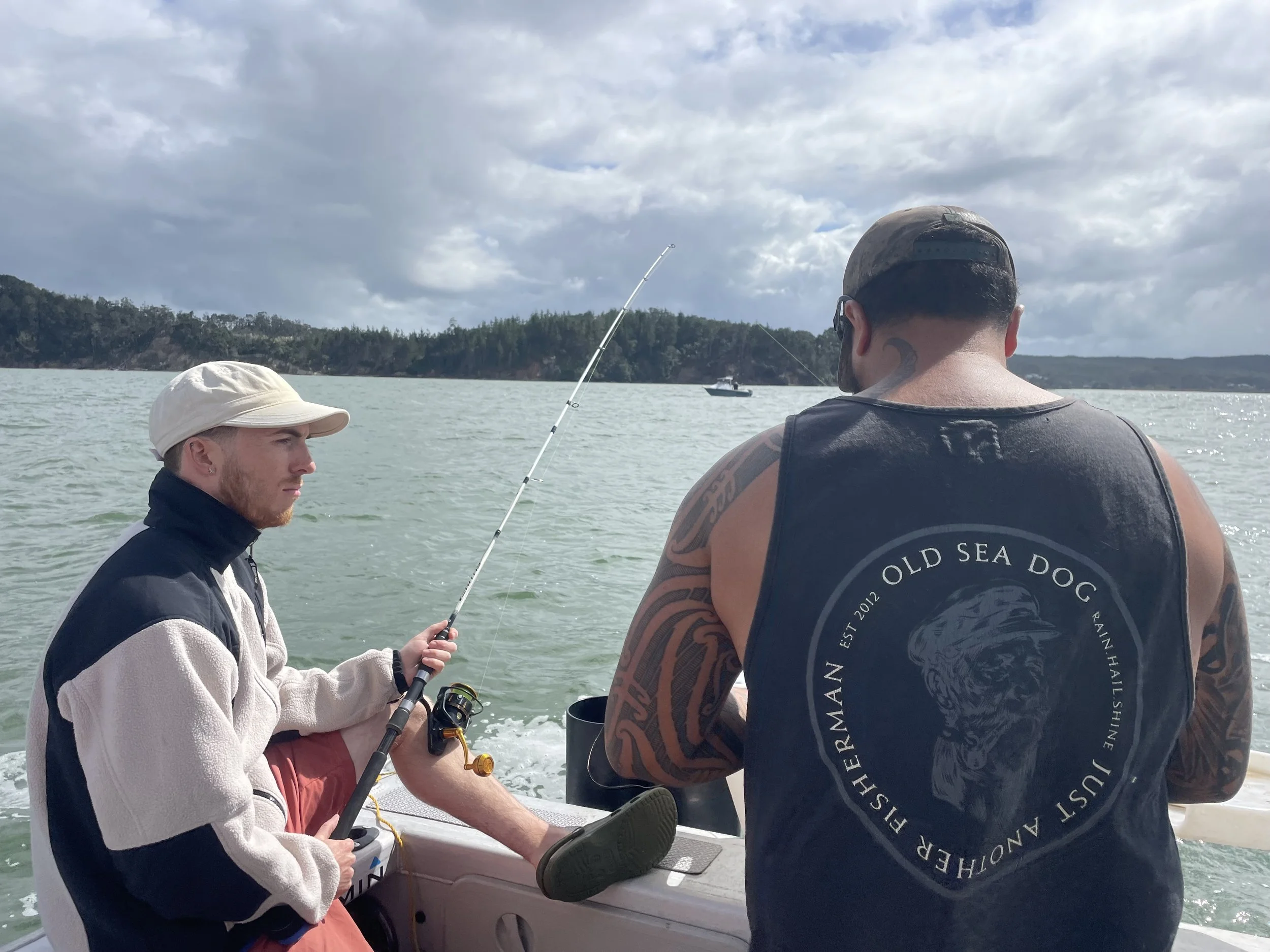
The next day, after going for nighttime hunting and getting three wild boars, Mina’s nephews took us fishing in what was probably the best experience of the weekend. I loved being out at sea, feeling the connection with the fish as it felt, bit, and mostly ate the bait without me catching it. I loved waiting around in the middle of the ocean, feeling the waves move the boat. One of Mina’s nephews told me that, in Māori culture, it is tradition to release the first fish you catch to thank the god of the sea for providing us with food. It is a sign of respect and appreciation. I was also told that it was tradition to kiss the first fish you caught, which later turned out to be a prank…!
The weekend ended with a trip to the school grounds for the hāngī. By then, we knew most faces; everyone greeted us, and we greeted everyone back. The hāngī in itself was a short-lived event. We ate quickly, then helped clear the school’s outdoor furniture, which had been taken out for the event. I felt that what is special about the hāngī is not the act of eating in itself; it’s everything that comes beforehand. It’s the whole community coming together to prepare the food on the marae, dig the hole, prepare the fire, come back the next day to light it, place the food in the hāngī pit, and then take it out a few hours later. Eating is only a short process, but the community’s work and love poured into this brief moment of food sharing make it memorable.
In retrospect, I wonder if conducting ‘good’ research is akin to a hāngī – whether the time spent engaging and building relationships with the community makes the experience not only memorable and valuable, but also more ethical. My research is ethical insofar as I got the University’s ethics approval, but I am unsure whether that is good enough (Boer Cueva et al., 2024, p. 7). I chose to share about my time in Tinopai because something about it felt different. While I often left interviews feeling like I merely extracted data from an informant, I left Tinopai with a full heart (and stomach) and a sense of ‘good’. So, I wonder: what was different? Perhaps it is that we allowed ourselves to slow down? And, by doing so, resisted the accelerated temporality of neoliberal academia (Kapsali, 2026, p. 4). Or perhaps it is that we shared tea, food, photo albums, and, most importantly, experiences. Or it is that I did not audio-record her and listened to her concerns about the protection of Indigenous intellectual property rights – which have been continually threatened for Indigenous people since colonisation (Brannelly et al., 2013). Could it be that I also connected with and learned not only from Mina, but also from her extended family and the Tinopai community? Or perhaps it is a combination of these?
While I do not claim this experience escaped the extractivist neocolonial framework of academic research, I cannot help but be inquisitive about the small ways in which it might have transcended it. Conducting slower research that centres relationality, brings hearts and feelings into research praxis (Haverkamp, 2021), respects cultural values (such as the importance of face-to-face communication, kanohi ki te kanohi), and is truly attentive to the voices of the community, the knowledge they offer, and the concerns they express strongly echoes an ethics of care. Scholars are celebrating and writing about how care as a methodological orientation has the potential to challenge extractive and hierarchical research practices (Camfield, 2025; Kapsali, 2026).
So, I keep pondering: how can we centre an ethics of care in our research practice, and what does that look like?
To be continued…
Sources
Berg, M., & Seeber, B. K. (2025). The slow professor: Challenging the culture of speed in the academy. University of Toronto Press.
Boer Cueva, A. R., Giri, K., Hamilton, C., & Shepherd, L. J. (2024). A decolonial feminist politics of fieldwork: Centering community, reflexivity, and loving accountability. International Studies Review, 26(1), viae003.
Brannelly, T., Boulton, A., & te Hiini, A. (2013). A relationship between the ethics of care and Māori worldview—the place of relationality and care in Maori mental health service provision. Ethics and Social Welfare, 7(4), 410-422.
Camfield, L. (2025). What Challenges for Global Development Research are Posed by a More Decolonial Approach? Colonial Genealogies and Responses: L. Camfield. The European Journal of Development Research, 37(2), 421-433.
Caretta, M. A., & Jokinen, J. C. (2017). Conflating privilege and vulnerability: A reflexive analysis of emotions and positionality in postgraduate fieldwork. The professional geographer, 69(2), 275-283.
England, K. V. (1994). Getting personal: Reflexivity, positionality, and feminist research. The professional geographer, 46(1), 80-89.
Haverkamp, J. (2021). Where's the love?: Recentring Indigenous and feminist ethics of care for engaged climate research. Gateways: International Journal of Community Research and Engagement, 14(2), 1-15.
Kapsali, M. (2026). For a caring geography: Situated solidarities and feminist care ethics during and beyond crisis. Area, 58(2), e70084.
Katz, C. (1994). Playing the field: questions of fieldwork in geography. The professional geographer, 46(1), 67-72.
Peake, L., & Trotz, D. A. (1999). Gender, ethnicity and place: Women and identities in Guyana. Psychology Press.
Rose, G. (1997). Situating knowledges: positionality, reflexivities and other tactics. Progress in human geography, 21(3), 305-320.
Sharp, J., & Dowler, L. (2011). Framing the field. A companion to social geography, 146-160.
Sultana, F. (2007). Reflexivity, positionality and participatory ethics: Negotiating fieldwork dilemmas in international research. ACME: An international journal for critical geographies, 6(3), 374-385.
Tuhiwai Smith, L. (2019). Decolonizing research: Indigenous storywork as methodology. Bloomsbury Publishing.
Tynan, L. (2024). Data collection versus knowledge theft: Relational accountability and the research ethics of Indigenous knowledges. In Challenging global development: Towards decoloniality and justice (pp. 139-164). Palgrave Macmillan.